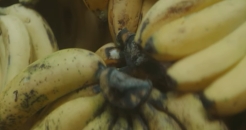
 An example of God's call to create
From a video by Faith Driven Entrepreneur
Jean‑Paul Nageri’s story begins on his father’s farm in eastern Uganda, where he spent much of his childhood observing the rhythms and struggles of small‑scale agriculture.
Every year around Christmas, traders would arrive promising to buy his father’s bananas in bulk. Excited by the prospect of income, his father would harvest large quantities - huge 50–70 kg bunches. But the traders rarely returned on time. In the hot Ugandan climate, bananas ripen rapidly once cut, and Jean‑Paul watched helplessly as entire harvests spoiled in front of his father’s eyes. The emotional weight of this repeated loss left a deep impression on him. He knew even then that he wanted to find a solution.
The scale of the problem extended far beyond his family. Across Africa, food waste is a trillion‑dollar crisis. Ghana alone loses billions annually to spoilage. Sub‑Saharan Africa loses roughly 40% of its food before it ever reaches consumers, largely due to post‑harvest challenges: heat, poor transport conditions, lack of storage, and inadequate preservation.
Aid agencies warn that millions face hunger each year, even as farmers lose enormous portions of their crops. Many farmers aren’t just growing food for themselves; they’re feeding their communities. Yet the system fails them long before their produce reaches the market.
Driven by the memory of his father’s losses, Jean‑Paul studied Agricultural Science at Uganda Christian University. He wanted to understand the science behind spoilage and find a practical solution that farmers could actually use. He learned about the cold chain - the temperature‑controlled system that keeps food fresh from farm to consumer in wealthier countries. But cold storage was far too expensive for most African farmers. His father dismissed the idea immediately. Even if farmers could afford it, cold storage often compromises freshness and nutrients, and it doesn’t solve the deeper structural issues.
Chemical fungicides were another option, but Jean‑Paul quickly discovered their dangers. They can cause health problems, damage soil, and create resistant strains of fungi. Synthetic solutions dominate global agriculture because they’re cheap and consistent, but they come with long‑term costs to human health and the environment. Organic alternatives exist, but they’re often expensive and inconsistent. Jean‑Paul found himself stuck between solutions that were either unaffordable or unsafe.
So he turned back to nature - and to God. He asked a simple but profound question: How does nature preserve itself? Why do some fruits last longer than others? Why do oranges stay fresh far longer than avocados? Observing the shiny, oily surface of orange peels, he wondered what made them so resilient. His research revealed that citrus peels contain natural oils - glycerides- that act like antibodies for the fruit. They form a protective shield, strengthening the fruit against spoilage, pests, and disease.
This insight became the turning point. If these natural oils protect oranges, could they protect other produce too?
Jean‑Paul spent countless nights in the university lab experimenting with ways to extract these oils. Eventually, he succeeded. But when he presented the liquid solution to his father, he received another practical challenge: farmers prefer powders, not liquids. So he returned to the lab and spent months figuring out how to convert the oils into a stable powder that could be mixed with water and sprayed onto produce.
When he finally tested the product on his father’s bananas, the results were astonishing. Bananas that normally spoiled within days now lasted weeks. His father was thrilled and urged him to bring the solution to farmers everywhere. That encouragement sparked Jean‑Paul’s entrepreneurial journey.
He named the product Kafesh - a natural, edible oil‑based spray that dramatically extends the shelf life of fruits and vegetables. Kafesh can double or triple the lifespan of produce at room temperature. Avocados that normally last less than a week can remain fresh for 20–30 days. Tomatoes can last months. Sweet potatoes can remain viable for half a year. In a continent where 40% of food spoils before reaching consumers, even cutting losses by half would unlock billions of dollars in value and transform food security.
Investors have taken notice. The problem is massive, measurable, and economically significant - exactly the kind of challenge that attracts global capital. But for Jean‑Paul, the motivation is deeply personal. His father’s heart condition made him rethink the chemicals used in farming. He recalls spraying synthetic pesticides in the field and needing to wash his hands multiple times with soap - yet those same chemicals ended up on the tomatoes people ate. He realised that anything truly good for the body should be simple, natural, and pronounceable.
Farmers across Kenya and Uganda often rely on synthetic chemicals because they act quickly. Natural solutions require patience. But Kafesh has won farmers over because it’s affordable - far cheaper than synthetic waxes and sealants - and because it works. It reduces costs by more than 50% compared to conventional methods. It preserves freshness without compromising health. And it offers farmers a way to protect their livelihoods without harming their land or their communities.
Jean‑Paul envisions Kafesh spreading across Africa and beyond, helping to end food insecurity and food waste. His journey shows that innovation doesn’t always come from high‑tech labs or billion‑dollar corporations. Sometimes it begins with a child watching his father’s harvest rot in the sun - and deciding that one day, he will find a better way.
Watch this 57 min video here:
Retweet about this article:
From a video by Faith Driven Entrepreneur, 01/04/2026