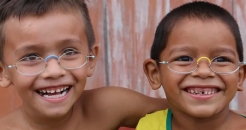
 Good vision for all people
From information from GoodVision Germany
According to a study by the World Health Organization (WHO), more than 950 million people need glasses but can not afford them or have no access to optical care. The consequences are serious: children have difficulties learning and adults are unable to take on any or any qualified work to secure the family income.
GoodVision want to change this.
What began in the basement of a terraced house in Erlangen, Germany has already helped more than a million people to a better life by 2025.
Having been dependent on glasses since childhood, Martin Aufmuth knew what it meant to have poor eyesight. Even while studying to become a teacher of mathematics and physics, he was concerned with the problems of the Global South, which have stayed with him to this day.
In 2010, he read in the book "Out of Poverty" by Paul Polak that one of the last great inventions for developing countries was a pair of glasses that people who live on one dollar or less a day could afford. He just thought, "It's a shame that this doesn't exist, the WHO or opticians' associations should take care of it and read on." In the end, it was his wife who inspired him to take action.
The goal was to create a pair of glasses that are robust and very inexpensive to manufacture. Martin experimented with various materials in his cellar until the first prototypes of the spring steel spectacles and the necessary bending device were ready.
With glasses and a bending machine in his luggage, he set off for various African countries. On site, Martin wanted to find out whether his idea would work. And it did. In Uganda, the first GoodVision Glasses were made by local people according to Martin's instructions and were immediately handed over to people who had been waiting a very long time for a pair of glasses.
Martin was certain that if his idea was to bear fruit, he would need supporters. Together with fellow teachers, he founded the EinDollarBrille association and set out in search of helping hands, bright minds and people who were willing to support the EinDollarBrille project with a donation.
The model today is as follows:
1. Medical examination and treatment
The most important step before the actual vision test is to identify eye conditions for which glasses cannot help. In this case, a referral is made to an ophthalmologist. In some countries, GoodVision also organises operations for cataracts or provides comprehensive basic ophthalmological care.
2. Vision tests
Before any pair of glasses is sold, a professional vision test must always be carried out by a qualified specialist. GoodVision organizes eye camps in remote villages, schools, factories or health centres to reach people who are unable to visit an optician for financial or logistical reasons.
3. Glasses & production
The GoodVision Glasses consist of a light but extremely stable spring steel frame. They are produced locally without electricity on a simple bending machine. The matching lenses can be inserted into the frame in one easy step. The material costs for a pair of glasses are around one US dollar and the selling price is two to three days’ local wages. The frames and lenses must meet high quality standards and withstand heavy strain.
4. Training and employment
GoodVision trains specialists in optics and eyewear production in the program countries. Opticians are trained according to uniform rules and current scientific standards, and the annual recertification of opticians is an important part of quality assurance. Around 500 people work for GoodVision in eleven countries in Asia, Africa and South America. This creates new jobs with prospects even in regions with poorly developed labour markets.
Martin Aufmuth's idea and his desire to change the world have given rise to a globally active organization that has been helping children and adults in Asia, Africa and South America to lead a better life since 2012. His commitment to good vision has been recognized several times.
With GoodVision, Martin has shown that courage and belief in a better world can achieve a great deal if you find people who believe in this idea.
Retweet about this article:
From information from GoodVision Germany, 22/07/2026